

ENTC Team Becomes the 2nd Runners Up of the IEEE Video and Image Processing Cup 2021
A team of undergraduate students (Team NFPUndercover) from the Department of Electronic and Telecommunication Engineering (ENTC) under the supervision of Dr. Chamira Edussooriya from ENTC, University of Moratuwa, became the 2nd runner up in the IEEE Video and Image Processing Cup (VIP Cup) 2021 competition at the 28th International Conference on Image Processing (ICIP) 2021. ICIP is an annual flagship conference of the IEEE Signal Processing Society which is one of the world’s premier associations for signal processing engineers, academics, and industry professionals. This year the conference was held from the 19th to 22nd of September 2021, virtually in Anchorage, Alaska, USA. The IEEE VIP Cup competition is one of the most prestigious competitions in video and image processing for undergraduate students. This year’s task was to develop a robust algorithm to estimate in-bed human poses under heavy occlusion caused by blankets and varying illumination conditions. This algorithm can be utilized for in-bed human behavior monitoring during sleep or rest state, which is crucial for prognostic, diagnostic, and treatment of many healthcare complications. Team NFPUndercover proposed a novel solution for this task leveraging multiple approaches from both computer vision and signal processing such as extreme occlusion-based data augmentation and label smoothening via knowledge distillation. Specifically, their approach is feasible to implement in a resource-constrained setup. Image Processing and Machine Vision is a branch of Artificial Intelligence that models and learns the image representations to autonomously accomplish downstream tasks such as Image Classification, Object Detection, Semantic Segmentation, etc. It utilizes advanced statistical and mathematical algorithms to make a machine see and understand the real world as humans do. This achievement by UoM places Sri Lanka at a higher position in the world of the image processing community
Read MoreUOM Emerged as the Champions of the Students Challenge in the ICAS 2021 Conference
Team DigitX, a team of ten undergraduates from the Department of Electronic and Telecommunication Engineering (ENTC) under the supervision of Dr. Chamira Edussooriya from ENTC, University of Moratuwa, emerged as the champions of the Students Challenge at the Internal Conference on Autonomous Systems (ICAS) 2021 conference. The conference was held virtually in Montreal, Canada from August 11 to 13, 2021.
ICAS 2021 is the premier international forum organized by the IEEE Signal Processing Society (SPS) through IEEE SPS Autonomous Systems Initiative, for presenting the technological advances and research results in the fields of theoretical, experimental and applied autonomous systems. IEEE ICAS was held for the first time this year and it focused on providing an updated state-of-the-art over advanced signal processing theories and techniques that are relevant for developing autonomous systems.
The ICAS 2021 Students Challenge was on “unsupervised anomaly detection through self-aware autonomous systems”, to detect abnormal events during the navigation of a ground/ aerial vehicle. The team was able to develop an unsupervised learning algorithm with state-of the-art signal processing and machine learning techniques such as auto-encoders, recurrent neural networks for time-series data signal processing.
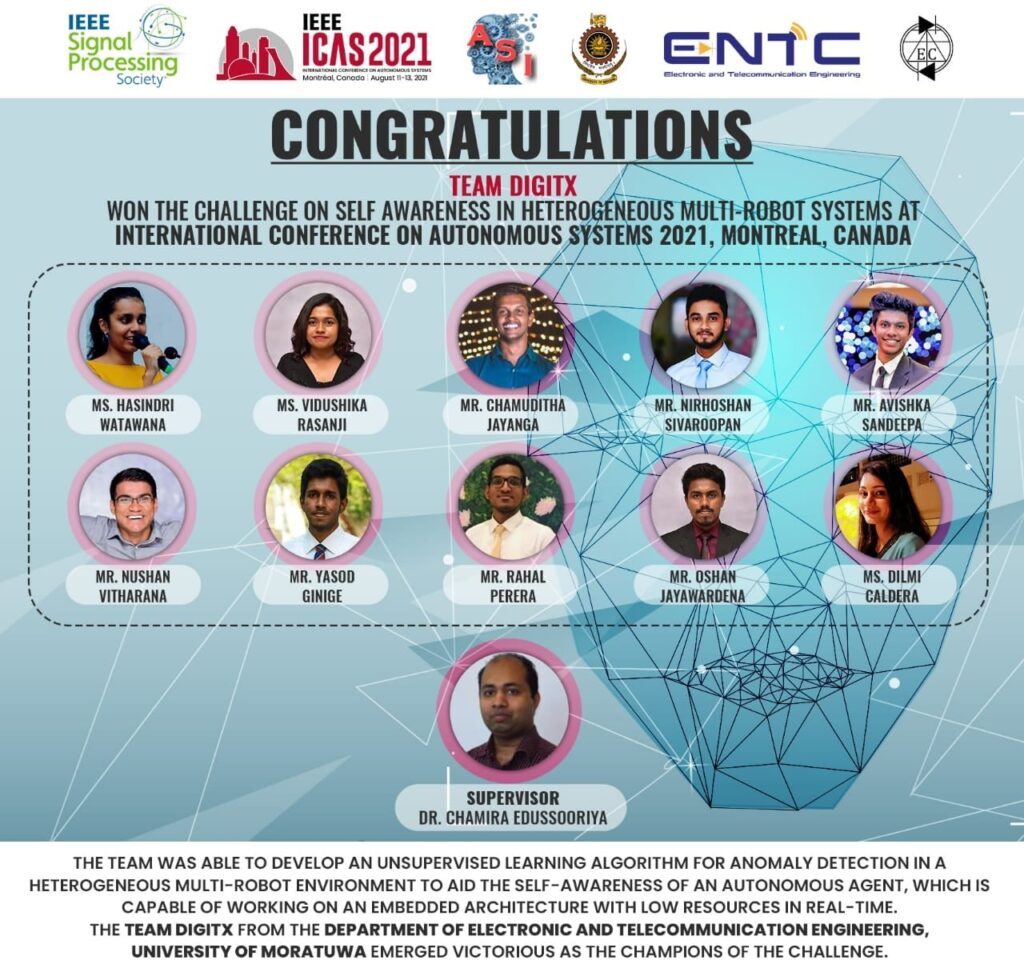
Based on the inertial measurement unit (IMU) sensor data, video data captured by the cameras of autonomous systems in several camera perspectives and light detection and ranging (LIDAR) sensor data (point clouds), the unsupervised model was trained to identify the normal situations that it saw during the training phase as normal and every other situation as abnormal (as per the challenge requirement a reference normal scenario was defined for each dataset). UoM won the first place while a team from Indian Institute of Technology (IIT), India and a team from CentralSupelec, France won first and second runners up, respectively.
An autonomous system is an artificial system capable of performing a set of tasks with a high degree of autonomy. Developing computing systems with advanced levels of autonomy has been a crucial task for decades in order to manage ever-increasing requirements in complexity. This achievement by UoM places Sri Lanka at a higher position in the world signal processing community.
Read More
ENTC Team Becomes Champions of the IEEE Signal Processing Cup 2021
A team of undergraduate students (Team T- Cubed) from the Department of Electronic and Telecommunication Engineering (ENTC) under the supervision of Dr. Prathapasinghe Dharmawansa from ENTC, University of Moratuwa, won the first place in the IEEE Signal Processing Cup 2021 competition at the ICASSP 2021 conference.
Read MoreENTC wins Group Category MERIT at the Manamperi Award (Engineering) 2020
A Final Year Research Project from the 2015 Biomedical Engineering Batch from the Department of Electronic and Telecommunication Engineering (ENTC), University of Moratuwa secured the “MERIT Award” of the Manamperi Award (Engineering) 2020 for the “Most Outstanding Undergraduate Engineering Research Projects” in the Group Category.
The Research Project group comprised of 4 students from the Biomedical Engineering Specialization: K.G.G.L.A. De Silva, J.K.M.V. Perera, K.R.B. Wickremasinghe, and A.M. Naim, and was supervised by Dr. S.L. Kappel from the Department of Electronic and Telecommunication Engineering and Dr. T.D. Lalitharatne from the Department of Mechanical Engineering.
The research project was focused on “Designing a Cost-Effective Active Dry Contact sEMG Sensor System for Controlling a Bionic Hand”. The goal of the project was to develop a cost-effective neural interface for individual finger-based wireless interaction using sEMG technology. The device is aimed to be a novel wearable technology with many applications, mainly for Bionic Hand Control Systems. In addition to this achievement, the group has published 2 international conference papers at IEEE ICASSP 2020 and IEEE SMC 2020, and have also gotten an “Honorary Mention” at IEEE ComSoC Student Comp. 2019.


The “Manamperi Award” is awarded by the Sri Lanka Association for the Advancement of Science (SLAAS) each year for the Most Outstanding Undergraduate Engineering Research Project. It is open to all Engineering graduates who have graduated from a recognized university of Sri Lanka and completed a Final Year Research Project (Individual or Group) within the duration of the year this award is presented.
Read MoreThe UoM Wins the 1st Runner Up Award in the SP Cup 2020
The UoM team won the 1st runner up award in the signal processing cup (SP Cup) 2020 competition attached to the International Conference on Acoustics, Speech, and Signal Processing (ICASSP), virtually held in Barcelona, Spain, from May 4 to 8, 2020. The winning team comprised of six undergrads of the Department of Electronic and Telecommunication Engineering (ENTC), and four undergrads of the Department of Computer Science and Engineering. Mr. Dumindu Tissera (a Ph.D. candidate of the ENTC) tutored and the team and Dr. Chamira Edussooriya (ENTC) supervised the team.
The SP Cup competition is an annual event organized by the IEEE signal processing society to encourage students to solve real-world problems using signal processing techniques. It is held as a sub-event of the ICASSP, which is the world’s largest and most comprehensive technical conference focused on signal processing and its applications, with more than 1500 research paper presentations each year.

This year’s SP Cup challenge was on “unsupervised abnormality detection by using intelligent and heterogeneous autonomous systems.” The UoM team employed a blend of signal processing techniques and state-of-the-art machine learning techniques, such as long short-term memory and conditional generative adversarial networks, to detect abnormalities (i.e., unusual or suspected events) using inertial measurement unit (IMU) sensor data and video data captured by the cameras of autonomous systems, e.g., drones. The proposed solution by the UoM team achieved 98% accuracy with IMU sensor data and 95% accuracy with video in detecting anomalies in the dataset provided for the competition. In the first round, the UoM team scored the highest among the participated teams from all around the world. In the final presentation, the team from the Technion – Israel Institute of Technology, Israel surpassed the UoM team.
Signal processing—” analyzing, modifying, and synthesizing signals such as sound, images, and scientific measurement”— is an important field in today’s information-rich world. This coveted achievement places the UOM within a substantial place in the signal processing community. The challenge is to continue excelling in the area of signal processing.
Read MoreUoM becomes the Runner Up in the CASS COVID-19 Special Student Design Competition
The UoM team won the first runner-up award in the 2020 CASS COVID-19 Special Student Design Competition organized as an event of International Symposium on Circuits and Systems (ISCAS) 2020. ISCAS is the flagship conference of the IEEE Circuits and Systems society with more than 750 research paper presentations in each year. The winner of the competition is a team represented the University de Toulon, France, and the second runner-up award won by a team represented the University of Rhode Island, USA.
The project of the UoM team, Intelliscope: A Low-Cost AI-powered Stethoscope for Cardiovascular Disease Management in Resource-Constrained Environments, proposed a low-cost wireless stethoscope with an artificial intelligence back-end to help both semi-trained and expert medical professionals to diagnose cardiac abnormalities while wearing personal protective equipment or maintaining a safe distance from the patient. The UoM team employed a blend of state-of-the-art biomedical engineering, digital signal processing and machine learning techniques to develop the Intelliscope.

Dr. Navinda Kottege from CSIRO, Australia Visits University of Moratuwa
Dr. Navinda Kottege, Senior Research Scientist and Research Team Leader with the Robotics and Autonomous Systems Group at the Commonwealth Scientific and Industrial Research Organization (CSIRO) in Brisbane, Australia visited the Department of Electronic and Telecommunication Engineering (ENTC), the University of Moratuwa on 6th January 2020. Dr. Navinda has been instrumental in hosting ENTC undergraduates as research interns at CSIRO as well as supervising final year projects as an external supervisor and providing robot hardware for the projects. A discussion on the progress of the final year projects was held at the department conference room with the participation of Dr. Peshala Jayasekara (ENTC), Dr. Thilina Lalitharatne (Mechanical Engineering) and Dr. Sulochana Sooriyaarachchi (Computer Science and Engineering), which was followed by a demonstration of the projects by the undergraduate students. Dr. Navinda also conducted a guest lecture on “Field Robotics” at the New Auditorium of the University of Moratuwa. In this talk, he gave an overview of the diverse research conducted at CSIRO’s Robotics and Autonomous Systems Group and explained about some specific technologies developed including SLAM and Legged robot locomotion.

Industrial IoT Initiative of the Year Award for Dialog-UoM products at GLOTEL Awards 2019
A range of IoT products developed at the Dialog-University of Moratuwa mobile communications lab won the coveted ‘Industrial IoT Initiative of the Year’ award at the 7th annual Global Telecoms Awards (GLOTEL Awards) held in London in November 2019.
The winning entry is a result of a 4-way partnership between Dialog, the University of Moratuwa, Axiata Digital Labs (ADL) and Lanka Electricity Company (LECO). As the award signifies, the partnership has demonstrated that home-grown technology can make a global impact.
The end-to-end IoT systems experience gained throughout this development process has also enabled the Department of Electronic & Telecommunication Engineering to introduce two new course modules for its undergraduates, as well as the Dialog-UoM lab to support several final year projects.
Read MoreInnovateFPGA 2019 – Regional Final – Asia Pacific and Japan Region – Iron Award
Humans are social beings, therefore communication with another happens everywhere in the world in various languages and through various devices. What about the mute community? They don’t have the opportunity to present their ideas to other people who can speak, without the help of another person who knows the sign language for interpretation or without the use of some device to do the translation. From the world’s population reportedly, there are a considerable amount of people suffering from speech disorders such as muteness, Apraxia (childhood/acquired) and Aphasia. These may occur due to brain damage, stroke, tumor or any other illness that affects the brain/ vocal cords/ mouth/ tongue etc. Since most of us do not understand sign language, for them to conduct a normal conversation with people like us they definitely need a source of translation. Our team came up with a design idea for a device to offer real-time sign language translation, to support efficient communication for the mute with the rest of the community who doesn’t understand sign language. We participated in InnovateFPGA 2019 to bring this idea to life and to make it our first steps to introduce our idea and findings to the world. The InnovateFPGA is a global FPGA design contest where teams from around the world compete as they invent the future of Artificial Intelligence with Terasic and Intel. This is a competition open to everyone including students, professors, makers and industry. We were able to feature engineer Electromyography (EMG) signals and signals from an Inertial Measurement Unit (IMU) obtained from a MYO armband (a wearable armband that consists of EMG pods and an IMU) and train a Neural Network to classify 5 sign language gestures. Once a model was built, we implemented this neural network on a De10-Nano Field Programmable Gate Array (FPGA) board, sent to us from Terasic to complete our project for the competition. We were able to interface the FPGA board via a Bluetooth connection with an Arduino since our final translation output was to be given as speech through a speaker. As second year undergraduates this was rather challenging, but we were able to secure the Iron Award at the Asia Pacific and Japan regional final round of the InnovateFPGA competition out of 30 teams. It was a great experience to have represented our country and bring glory to our university and nation. We are extremely thankful for the academic and non- academic staff of our department for their advices and immense support given to us. We wouldn’t have come this far in this competition if it weren’t for them. After this successful phase we are hoping to further improve our recognition algorithm and output full sentences using Natural Language Processing. We believe our findings will benefit this community largely in the future.

