
A Research on an Open-Source 2.4 GHz LC-VCO Fractional-N PLL in 130-nm BiCMOS Accepted for Publication in the SMACD 2026
A paper has been accepted for publication in the SMACD 2026, the International Conference on Synthesis, Modeling, Analysis, and Simulation Methods and Applications to Circuit Design. This will take place in Dresden, Germany. The authors of the paper are Manimohan Thiriloganathan, Shenal Ranasinghe, Avishka Herath, Rajinthan Rameshkumar, Hansa Marasinghe, and Anjana Viduranga. The work is mainly supervised by Kithmin Wickremasinghe and co-supervised by Gayangana Leelarathne. It is the first paper of its kind in Sri Lanka and from the Department of Electronic and Telecommunication Engineering (ENTC).
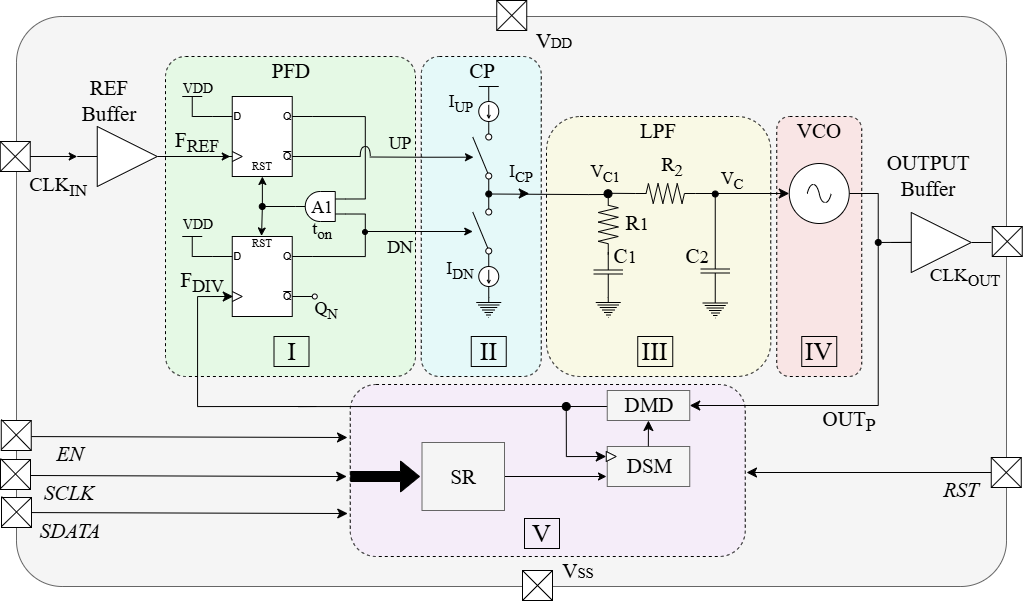
The research is titled “ A 2.4 GHz LC-VCO Fractional-N Phase Locked Loop Open-Source Design in 130-nm BiCMOS.” This work presents a 2.4~GHz type-II fractional-N PLL implemented in the IHP SG13G2 130nm BiCMOS open-source technology. Consequently, prior work relies on ring-oscillator-based voltage-controlled oscillators (VCOs) with degraded phase noise performance due to limited open-source passive device models. The proposed design employs a cross-coupled differential LC-VCO integrated with a custom-designed spiral inductor, developed using an open-source electromagnetic modelling workflow in OpenEMS. This helps address challenges in accurate passive component design in open RF design environments.
The optimized inductor achieves an inductance of 4 nH and a quality factor of 16.8 at 2.45 GHz. The LC-VCO sensitivity is approximately 120 MHz/V, while the PLL phase noise is -100.8 dBc/Hz at a 1 MHz offset. The complete PLL is realized using a fully open-source electronic design automation (EDA) flow, occupying a total area of 660 µm × 526.5 µm (≈ 0.347 mm²) and consuming 12.73 mW, demonstrating the feasibility of RF integrated circuit design in an open-source CMOS IC design ecosystem.
This work originated from the Department of Electronic and Telecommunication Engineering (ENTC), University of Moratuwa. It reflects the growing strength of research in RF integrated circuit design in Sri Lanka. It also reinforces the department’s contribution to open-source semiconductor design and advanced wireless communication systems.