

The field of Electronic and Telecommunications plays a vital role in the progress of the country. Thus our graduates are able to seek out opportunities to provide innovative solutions to real-life problems using their expertise, and contribute towards the economic development of the country. Our graduates have the foresight to drive industry in new directions capable of exploiting their expertise to the fullest.
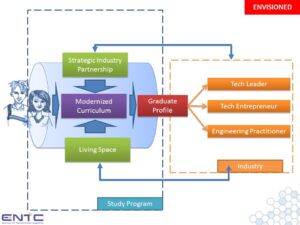
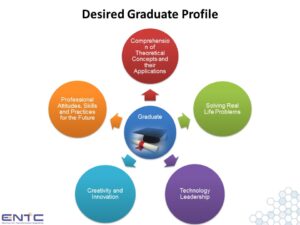
Program Educational Objectives (PEOs) represent the expectations of the department for its students 5 years after graduation. An ENTC graduate is to be seen as a
- Technology Leader
- Technology Entrepreneur
- Engineering Partitioner
The department’s objective is not only to produce professional engineers but technology leaders who can provide innovative solutions to the complex and challenging problems. The Program Outcomes of ENTC are,
- Apply knowledge of mathematics, natural science, computing and engineering fundamentals, and the engineering
specialization to develop solutions to complex engineering problems - Identify, formulate, research literature and analyse complex engineering problems to reach substantiated conclusions with
holistic considerations for sustainable development. - Design creative solutions for complex engineering problems and design systems, components or processes to meet identified
needs with appropriate consideration for public health and safety, whole-life cost, net zero carbon as well as resource, cultural,
societal, and environmental considerations as required. - Conduct investigations of complex engineering problems using research methods including research based knowledge, design
of experiments, analysis and interpretation of data, and synthesis of information to provide valid conclusions. - Create, select and apply, and recognize limitations of appropriate techniques, resources, and modern engineering and IT
tools, including prediction and modelling, to complex engineering problems. - Analyse and evaluate sustainable development impacts to society, the economy, sustainability, health and safety, legal
frameworks, and the environment, when solving complex engineering problems. - Apply ethical principles and commit to professional ethics and norms of engineering practice and adhere to relevant national
and international laws. And demonstrate an understanding of the need for diversity and inclusion. - Function effectively as an individual, and as a member or leader in diverse and inclusive teams and in multi-disciplinary, face-
to-face, remote and distributed settings. - Communicate effectively and inclusively on complex engineering activities with the engineering community and with society at
large, such as being able to comprehend and write effective reports and design documentation, make effective presentations,
taking into account cultural, language, and learning differences. - Apply knowledge and understanding of engineering management principles and economic decision-making and apply these
to one’s own work, as a member and leader in a team, and to manage projects and in multidisciplinary environments. - Recognize the need for, and have the preparation and ability for i) independent and life-long learning ii) adaptability to new
and emerging technologies and iii) critical thinking in the broadest context of technological change.
Program Outcomes Till 2019 Intake
PO 1: Apply mathematics, science, engineering fundamentals and an engineering specialization to the conceptualization of engineering models.
PO 2: Identify, formulate, research literature and solve complex engineering problems reaching substantiated conclusions using first principles of mathematics and engineering sciences.
PO 3: Design solutions for complex engineering problems and design systems, components or processes that meet specified needs with appropriate consideration for public health and safety, cultural, societal, and environmental considerations.
PO 4: Conduct investigations of complex problems including design of experiments, analysis and interpretation of data, and synthesis of information to provide valid conclusions.
PO 5: Create, select and apply appropriate techniques, resources, and modern engineering tools, including prediction and modeling, to complex engineering activities, with an understanding of the limitations.
PO 6: Function effectively as an individual, and as a member or leader in diverse teams and in multi-disciplinary settings.
PO 7: Communicate effectively on complex engineering activities with the engineering community and with society at large, such as being able to comprehend and write effective reports and design documentation, make effective presentations, and give and receive clear instructions.
PO 8: Demonstrate understanding of the societal, health, safety, legal and cultural issues and the consequent responsibilities relevant to engineering practice.
PO 9: Understand and commit to professional ethics and responsibilities and norms of engineering practice.
PO 10: Understand the impact of engineering solutions in a societal context and demonstrate knowledge of and need for sustainable development.
PO 11: Demonstrate a knowledge and understanding of management and business practices, such as risk and change management, and understand their limitations.
PO 12: Recognize the need for, and have the ability to engage in independent and life-long learning.
PO 13: Demonstrate a knowledge and understanding of contemporary technologies, their applications and limitations, contemporary research in the broader context of relevant fields.
PO 14: Demonstrate the ability to succeed in national and international competitive events in the relevant fields.